
Article · April 26, 2026
Rethinking Fix It Right the First Time (FIRFT): A Proposal for True Quality Measurement
A breakdown of why traditional FIRFT metrics fall short in the automotive industry and how to accurately track true service success.
By Moe Yassine

Fix it Right the First Time (FIRFT) is arguably the most critical service metric for any industry involving post-sale technical repair, a truth amplified within the complex ecosystem of the automotive sector. A high FIRFT score is a vital indicator of operational health, providing essential insights into four key areas of service excellence:
- The efficiency and performance of the service network
- The overall competence of service technicians
- Specific content gaps requiring updates in training materials
- The root causes of unnecessary warranty expenditures
Crucially, reducing the measurement latency of FIRFT allows it to serve as a near real-time detector of emerging quality issues and underlying trends.
Limitations of the Traditional Calculation
The conventional calculation for FIRFT, the ratio of successfully completed jobs on the first visit to the total number of jobs within a period, is deceptively simple. However, collecting accurate data is profoundly challenging, especially given the intricate manufacturer-service network relationship common in the mobility industry.
The reliance on post-service customer surveys introduces significant measurement risk. Premature surveying can lead to false positives, where a customer reports a successful fix before a recurrence, while delayed surveying may result in false negatives if the customer has forgotten the incident or is no longer engaged.
A more fundamental limitation arises when repeat repairs are defined narrowly by whether a physical repair was logged on the vehicle. This focus artificially deflates the measured repeat repair rate. For example, a customer may bring a vehicle in multiple times for the same issue, yet a repair is only logged on the final successful attempt because, in the preceding visits, the vehicle was incorrectly diagnosed as "working as intended".
To achieve a true FIRFT measurement, we must analyze the full service lifecycle where a job may fail:
- Intake Process: Misinterpretation or inadequate capture of the customer’s reported symptom.
- Diagnosis: Incorrect identification of the root cause.
- Repair Execution: Improper or incomplete execution of the prescribed fix.
Defining the True FIRFT Metric
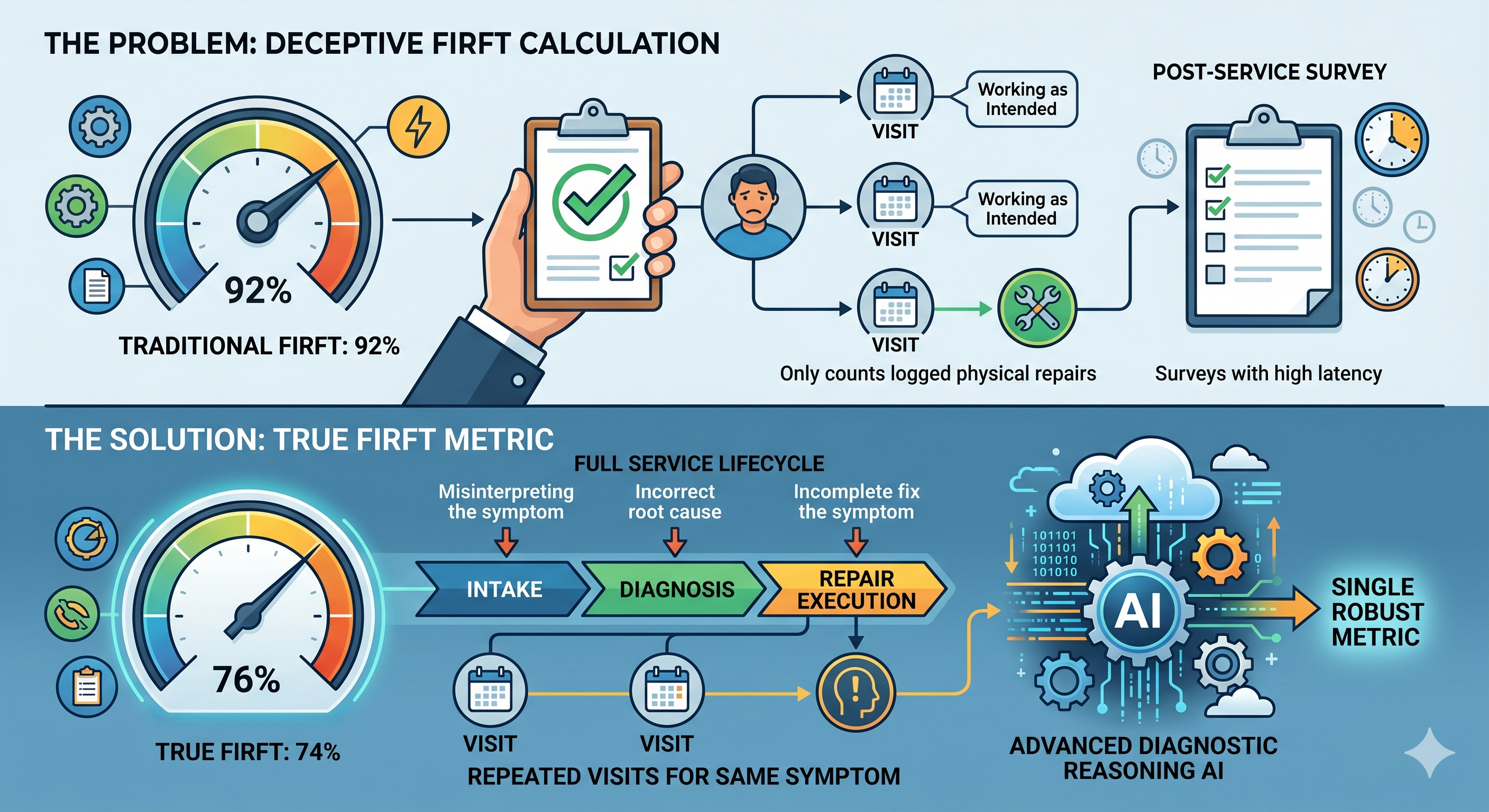 To accurately measure FIRFT, the industry must pivot from tracking logged repairs to tracking the
number of service visits a customer makes for the same reported symptom. This requires a single,
robust metric that can identify and compare specific variables across service visits within a
defined timeframe, ensuring that an unresolved issue is correctly matched as a recurring symptom.
This level of precision is achievable through advanced diagnostic reasoning tools that can
automatically correlate reported symptoms and underlying root causes, providing the foundation
for improved first-time fix rates.
To accurately measure FIRFT, the industry must pivot from tracking logged repairs to tracking the
number of service visits a customer makes for the same reported symptom. This requires a single,
robust metric that can identify and compare specific variables across service visits within a
defined timeframe, ensuring that an unresolved issue is correctly matched as a recurring symptom.
This level of precision is achievable through advanced diagnostic reasoning tools that can
automatically correlate reported symptoms and underlying root causes, providing the foundation
for improved first-time fix rates.
Filed under